The case of the missing Goya
Sir John Francis Godolphin Osborne, the 11th Duke of Leeds was, by all accounts, a lover of the good life. After inheriting the title and estates of his Dukedom at the tender age of 26 he spent most of the rest of his life as a tax exile in France and the Channel Islands where he eventually drank himself to death at the age of 62.
In 1961 Sotheby’s auctioned off his estate, including furniture, sculptures, and the 1812 Portrait of the Duke of Wellington by Goya which had lain for some years in a vault in The Channel Islands.
The painting was bought by American oil magnate and philanthropist Charles Bierer Wrightsman for £140,000, the equivalent of nearly £4Million in 2025 prices.
However, there was something of a national outcry that such a painting was to be lost to the nation, so the government of the time put an export ban on it, meaning that if matching funds could be raised, it could be kept in the UK.
The National Gallery managed to get the Kays Catalogue magnate, Isaac Wolfson, to stump up £100,000 of the purchase price, with the government providing the additional £40,000 as a grant to keep the picture in the UK, and it was duly put on display in the vestibule of The National Gallery on Trafalgar Square.
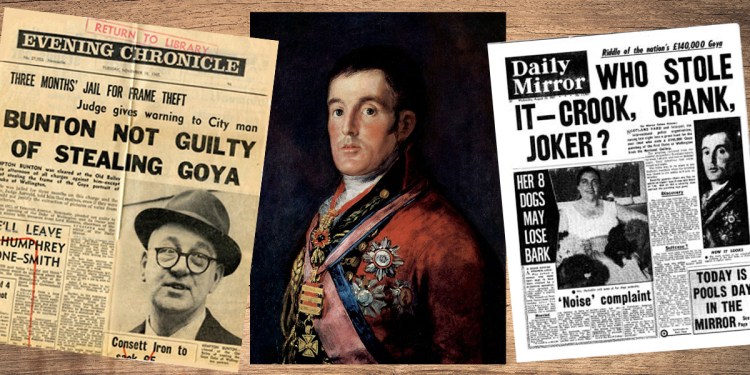
Unfortunately, as it was being displayed behind a roped off area, on a piece of mobile display board, it was the only painting in the whole gallery not hooked up to the alarm system, and in the early hours of 21st of August 1961 it was stolen.
The Met determined that the thief had entered by scaling over an eleven-foot wall, and got in through a second floor lavatory window.
As the theft was fifty years to the day since the theft of The Mona Lisa from The Louvre in Paris, they made it known that they thought it was the work of some international master criminal. Interpol interviewed over 1000 suspects.
It’s one of those stories that was big at the time – so big, in fact, that the painting even appears in the first Bond film, Dr No, in 1962, where it is standing on an easel in Dr No’s lair as Sean Connery’s Bond enters…
The trail of the real life crime went cold however until, in 1964, first Reuters, then The Daily Mirror received a number of messages apparently from the thief, in which they wanted to return the painting, on the proviso that it would be placed on public display to raise money for charity (the thief being incensed that £40,000 of public money had been used to help purchase it in the first place).
The painting was recovered from the left luggage office of Birmingham New Street Station in early 1965, and The Daily Mirror sent their best sketch artist to interview the clerk, who was able to give a detailed description of the man who’s deposited it, which the paper duly published.
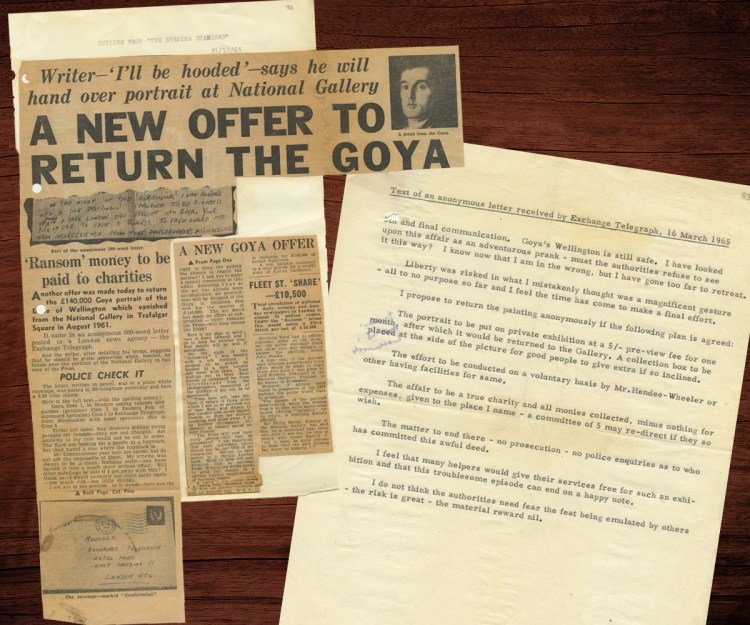
Although the paper had agreed to hire a hall and put the painting on display, as soon as it had been recovered and authenticated The National Gallery reneged on the agreement, setting not only the editor of The Daily Mirror, but also the whole of Fleet Street against them.
Shortly after the publication of the artists impression in The Daily Mirror an overweight unemployed former bus driver from Newcastle walked into a police station and handed himself in for the crime. That man was Kempton Bunton.
He appeared to know everything about the painting, claiming that he’s stolen it to put on display to raise funds for his ongoing campaign for ‘Free Television Licenses for the Pensioners of the North East’.
The Establishment of the time was baying for blood, and Kempton was as good a suspect as any, so he was charged and brought to court in 1965, though because of the way Fleet Street had been double crossed, the press were determined to portray him as a working class hero keen to stick two fingers up to The Establishment for misuse of taxpayer funds, rather than the international art thief the police had in their sights.
For many years Bunton had been an amateur playwright, and although he’d never managed to get anything produced, he was a likeable man, and was good with words, especially his endearing use of malaphors (a figure of speech where two different idioms or phrases are unintentionally combined, creating a new, often humorous, expression).
Far from being the anticipated slam-dunk for the prosecution, his barrister Jeremy Hutchinson, QC – who had a few years previously successfully defended Alan Lane’s case for publishing Lady Chatterley’s Lover, and thereby allegedly set the 1960’s swinging – was able to successfully undermine the whole prosecution case.
Kempton never managed to get any of his plays performed in his lifetime, and went back to relative obscurity, finally dying in 1976 as the only man ever to have stolen a painting from The National Gallery and gotten away with it.
The painting is now safely back in Room 38 of The National Gallery and free for anyone to visit.
 Kempton Bunton The Musical